
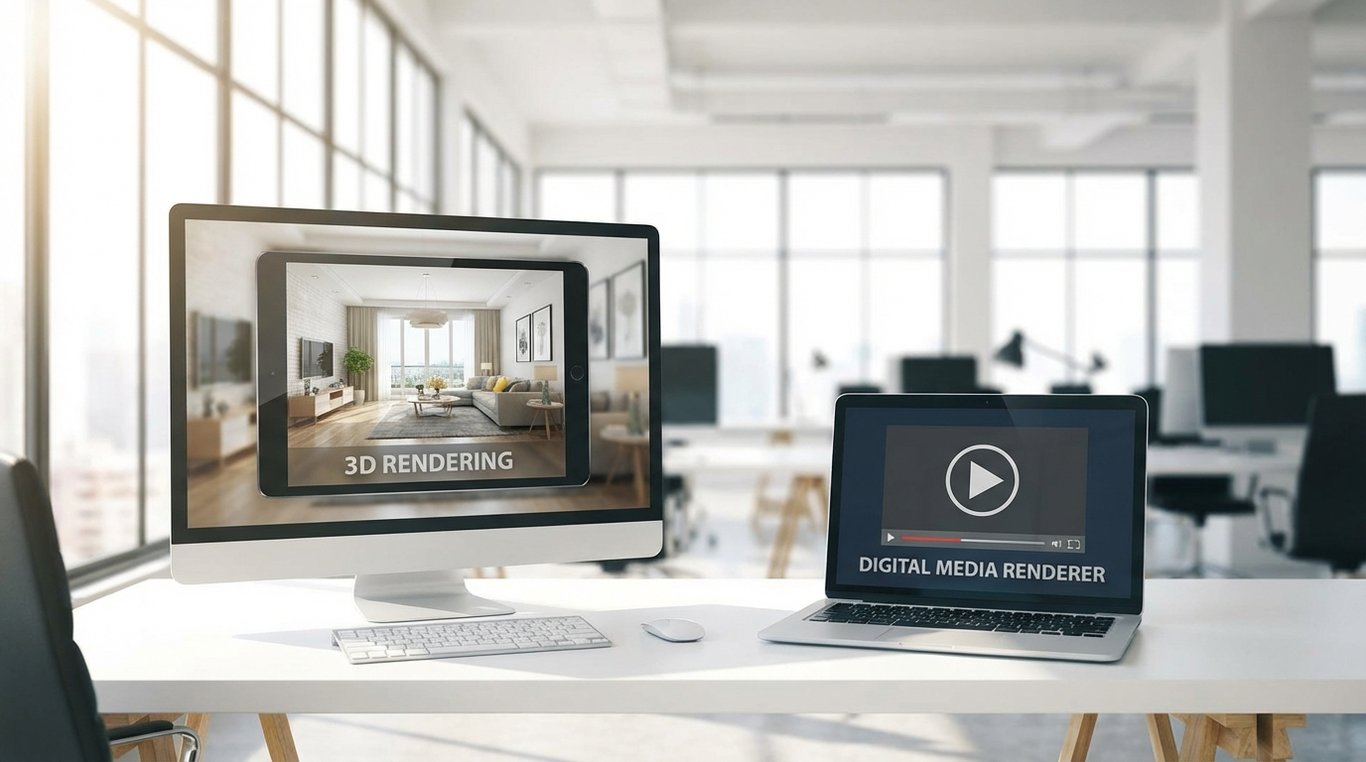

If your team has ever asked for “renderings” and received quotes that seemed impossible to compare, you have already run into the core issue behind blog/what is a digital media renderer vs 3d rendering. In real estate, these phrases are often used interchangeably, even though they refer to different things. A digital media renderer usually describes the person, studio, or service producing visual assets for marketing. By contrast, 3D rendering is a specific production method that creates images, animations, or walkthroughs from a three-dimensional digital model.
That difference matters because it changes the scope of work, the files a vendor needs, the timeline you should expect, and the kind of result you will get. A listing agent marketing a vacant resale condo may only need virtual staging and photo enhancement. A developer launching a pre-construction project may need photoreal interiors, exteriors, and amenity scenes built from plans. Both projects involve visual media, but the workflow, pricing logic, and approval process are very different.
For real-estate professionals, understanding this distinction is not just a semantic exercise. It improves vendor selection, makes briefs more precise, reduces revision cycles, and helps teams invest in the right visual tool for the right business objective. Whether the goal is to improve an MLS gallery, communicate a renovation concept, or sell homes that do not yet exist, clarity on the difference between a digital media renderer and 3D rendering leads to better marketing decisions.
Understanding blog/what is a digital media renderer vs 3d rendering in real estate
The clearest way to understand blog/what is a digital media renderer vs 3d rendering is to separate the provider from the production technique. In many real-estate conversations, a digital media renderer is an umbrella term for whoever creates visual marketing assets. That could be a freelance specialist, a rendering studio, a creative agency, or a platform-backed production team. The actual outputs can vary widely, including virtually staged listing photos, decluttered interiors, renovation concepts, architectural CGI, animated tours, branded sales graphics, or hybrid visual packages that combine several methods.
3D rendering is narrower and more technical. It refers to the creation of visual output from a 3D digital model. That model may be built from floor plans, elevations, CAD files, BIM data, survey measurements, finish schedules, and reference photography. Once the model is created, the rendering process adds materials, lighting, furniture, landscaping, environmental context, and camera views to produce images or animations that look realistic enough for marketing or presentation use.
This distinction matters because many vendors use broad marketing language that can hide major differences in capability. One company may call itself a digital media rendering service while primarily delivering photo-based virtual staging and image edits. Another may use nearly identical language while specializing in full architectural visualization for developers and design teams. If a brokerage or developer requests “renderings” without clarifying the method and expected deliverable, the proposals that come back may not be comparable at all.
In practice, it helps to think of digital media rendering as the broad business function and 3D rendering as one specific tool within that larger category. That framing leads to better questions from the start. Are you enhancing existing photographs, or visualizing a future state that cannot yet be photographed? Are you trying to show livability, or trying to show a property that has not been built? The answer determines almost everything that follows.
For teams that want more context on how the role is used in property marketing, Digital Media Renderer in Real Estate Listings gives a more focused explanation of where these services fit in listing workflows.
What a digital media renderer actually does in property marketing
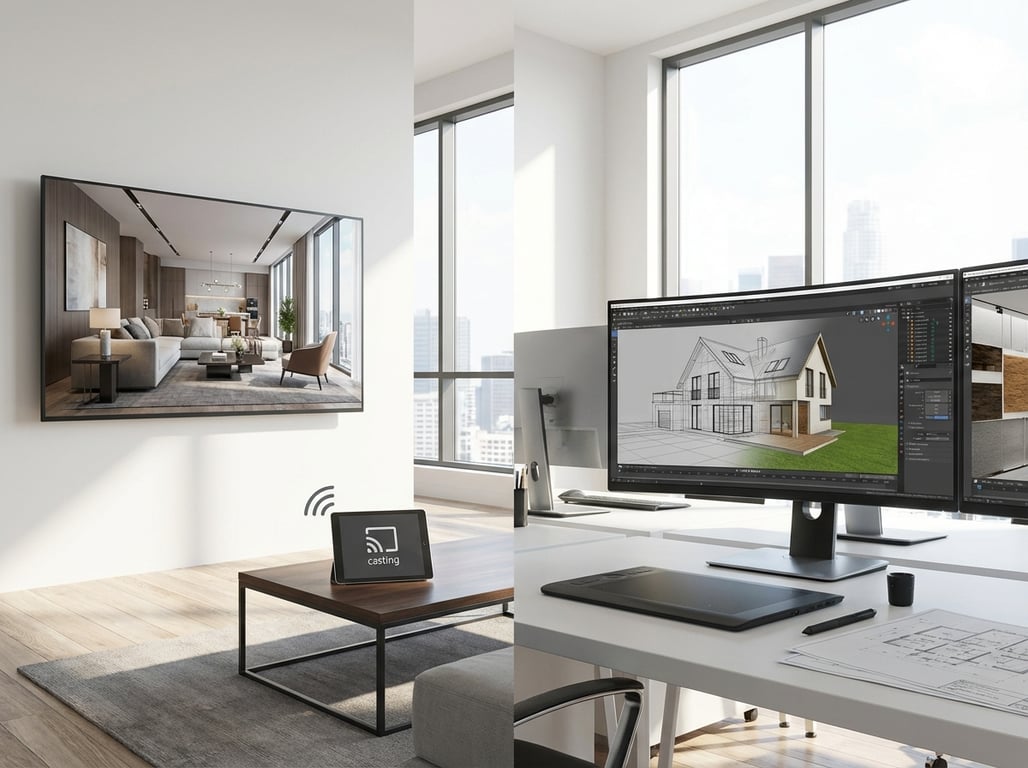
In real estate, a digital media renderer does not necessarily build a complete 3D environment from scratch. Quite often, the work begins with photography that already exists. The provider then improves, edits, or transforms those images so they communicate the property more effectively. That can include virtual staging, item removal, decluttering, lawn enhancement, sky replacement, lighting correction, day-to-dusk edits, renovation overlays, and branded visuals for presentation decks or listing campaigns.
This kind of work is especially valuable when a property is real and available to photograph, but the current visual condition is limiting its market appeal. Empty rooms can feel smaller than they are. Dated finishes can overwhelm otherwise good architecture. Personal belongings can distract from the layout. Exterior photos taken under poor weather conditions can undersell curb appeal. A digital media renderer helps bridge the gap between what the camera captured and what the buyer needs to understand.
For agents and brokers, that flexibility is one of the biggest advantages of hiring a digital media renderer. The work can often move quickly because it builds on existing visual material rather than waiting for a full 3D production pipeline. If a listing is launching within days and the goal is to make vacant spaces feel furnished, improve image consistency, or present a cleaner exterior hero shot, this broader digital media approach is often the most practical choice.
At the same time, the term can be misleading if teams assume it automatically means high-end architectural CGI. The title alone does not tell you whether the provider specializes in basic image enhancement, virtual staging at scale, conceptual renovation visuals, or true 3D scene creation. That is why real-estate professionals should always ask what process will be used, what files are required, and what kind of final output will be delivered. The label is broad; the workflow may not be.
What 3D rendering means for listings, renovations, and development sales
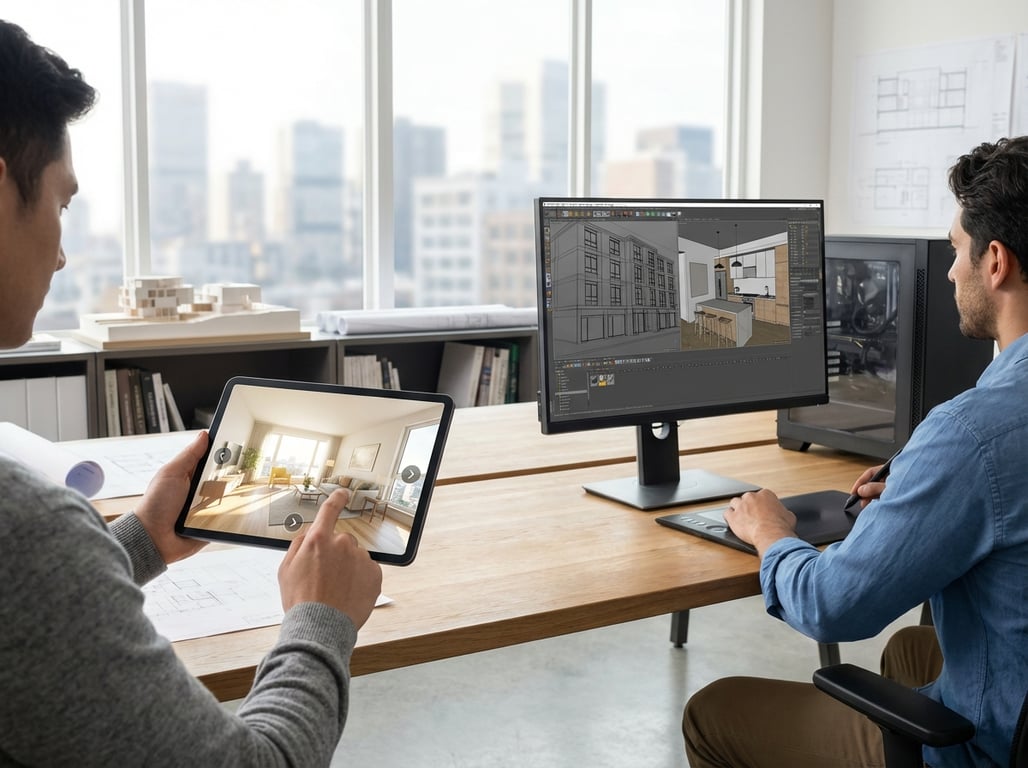
3D rendering is a model-based visualization process. Instead of altering an existing photograph, the provider creates or works from a digital model of the property and renders images from that model. Because the scene is not dependent on a camera standing in a finished room, 3D rendering can show spaces that are not built, not renovated, or not yet finalized.
This is why 3D rendering plays such a central role in development marketing. Buyers evaluating a presale condo, a custom home, or a mixed-use project need a clear visual sense of what is being offered long before traditional photography becomes possible. Rendered exteriors can communicate architecture, scale, and context. Rendered interiors can show finish level, room proportions, and brand positioning. Amenity visuals can make abstract promises feel tangible.
The same principle applies to significant renovations and repositioning projects. If the sales story depends on a changed floor plan, upgraded finishes, or a major reimagining of the property, photographs of the current condition may not be persuasive enough. A polished 3D render can show the post-renovation result in a way that edited photography often cannot, especially when the transformation involves moving walls, changing cabinetry, rebuilding facades, or redesigning circulation.
What many clients underestimate is that 3D rendering is not simply a visual style. It is a production pipeline. The process usually involves modeling geometry, applying materials, setting realistic lighting, furnishing scenes, selecting viewpoints, rendering high-resolution outputs, and refining them in post-production. That means the quality of the source materials matters. Incomplete plans, unclear finish schedules, or unresolved design decisions create assumptions, and assumptions lead to revisions.
That is also why pricing for 3D rendering varies so widely. A refined CGI image reflects design interpretation, modeling labor, technical setup, rendering time, and artistic polish. It is not merely a more expensive photo edit. It is a different kind of product built through a more demanding workflow.
Why the difference affects scope, budget, and turnaround
For real-estate professionals, the most practical consequence of this distinction is operational. When you know whether a project is really a digital media enhancement job or a full 3D rendering assignment, vendor comparisons become more accurate and expectations become more realistic.
Photo-based digital media work is often faster because the visual foundation already exists. The provider is not starting from zero. The scope is usually defined by the number of images, the complexity of the edits, the chosen style, and the turnaround requirement. If an agent needs five rooms virtually staged and two exterior shots improved before a listing goes live, the work may be completed quickly with relatively little internal coordination.
A 3D rendering project follows a more layered path. Before a final still image can be approved, the provider may need to build the space digitally, assign materials, select or model furniture, establish camera angles, create believable daylight or evening lighting, add contextual details, and then generate final outputs for review. Timelines depend not only on production speed but also on the completeness of the source information and the speed of stakeholder approvals.
Budget should follow that reality. Much of the confusion in this category comes from using one generic word to describe two very different levels of work. One vendor may be quoting a virtual staging package based on listing photos. Another may be quoting a full CGI package created from architectural plans. Both may use the word “rendering,” but the labor, expertise, and revision risk are not remotely comparable.
Internal workload changes as well. A straightforward digital media enhancement assignment may only involve the agent, a photographer, and a marketing coordinator. A 3D rendering package may require input from architects, designers, developers, project marketers, and sometimes legal or compliance reviewers. If the approval chain is not aligned before production starts, the project can slow down regardless of how skilled the vendor is.
Choosing the right approach for different property scenarios
In resale real estate, the first question is whether the property can already be communicated effectively through current-condition photography. If the answer is yes, but the images need help, a digital media renderer is often the better fit than a full 3D rendering team. Virtual staging, cleanup, sky replacement, or minor conceptual overlays may be enough to improve buyer response without adding unnecessary complexity.
Vacant homes are a common example. Buyers often struggle to interpret scale and function in empty rooms, especially online where image attention spans are short. A virtually staged image can make a living room feel proportionate and show how furniture placement supports flow. In that case, building a complete 3D model would usually be unnecessary unless the property is also being marketed with a redesign concept.
Properties with dated interiors create a more nuanced decision. If the home is fundamentally marketable and the goal is simply to soften buyer resistance, image enhancement or light renovation concepts may be sufficient. But if the sales strategy depends on helping buyers see a substantially transformed future state, then 3D rendering may provide more value because it can show the intended design with greater clarity and control.
Luxury real estate often sits between these two approaches. At the high end, authenticity matters, and many properties benefit most from exceptional photography supported by discreet visual refinement. However, luxury listings that are being repositioned, expanded, or sold with an architectural concept may justify 3D rendering because the future potential is part of the value proposition. In those cases, the render is not replacing reality; it is explaining an opportunity.
For new development, 3D rendering is often indispensable. When the product does not yet exist in physical form, photography cannot carry the marketing effort. Exterior hero images, interior perspectives, lobby views, rooftop scenes, and amenity visuals become the tools that help buyers understand the project. The most effective development teams are selective about what they commission. They prioritize scenes that answer buyer questions and reinforce the project's positioning rather than generating visuals just for volume.
For investors and value-add opportunities, the right choice depends on the narrative. If the asset is stabilized and the emphasis is on current performance, polished photography and supporting graphics may be enough. If the upside depends on redevelopment, conversion, or major renovation, concept renderings can reduce uncertainty and make the proposed transformation easier to evaluate.
How to brief vendors so the visuals match the business goal
Many disappointments in this category begin with an incomplete brief. Real-estate teams often ask for “a render” without defining the objective, the source materials, or the intended audience. That leaves too much room for interpretation and makes it harder to compare quotes meaningfully.
A strong brief starts with purpose. Is the visual intended for an MLS gallery, a listing website, a social campaign, a brochure, a pitch deck, or a presale presentation center? Usage shapes everything from aspect ratio to realism level. A hero image for a luxury launch needs a different level of refinement than a quick concept visual for an internal strategy meeting.
The next priority is source material. If you already have professional photography, that points toward one set of production options. If you have floor plans, CAD files, finish selections, elevations, and site references, that points toward another. Vendors can only price and schedule accurately when they understand what information is available and what still has to be interpreted or created.
Audience should be defined just as clearly. A first-time buyer, a downsizer, an investor, and a luxury purchaser respond to different cues. Styling, mood, furniture density, lighting warmth, and the amount of visible lifestyle detail should align with the intended market. A technically accurate visual that misses the buyer profile can still fail commercially.
It is also wise to establish revision parameters early. Small changes such as adjusting accessories or swapping a wall finish are different from redesigning cabinetry, changing architecture, or revising floor plans after the scene has been built. Teams that set revision expectations upfront tend to protect both budget and timeline more effectively.
For additional background on how these services fit into broader property marketing workflows, What Is a Digital Media Renderer for Real Estate offers useful context for teams comparing vendors and deliverables.
Common misconceptions that cost real-estate teams time and money
One of the most common misconceptions is that all polished visuals serve the same purpose. They do not. A virtually staged photo, a renovation overlay, and a fully modeled 3D render may all look professional, but they solve different business problems. If the audience needs to understand a future building or a radically changed layout, simple enhancement work will not be enough. If the audience only needs to imagine furniture in an empty room, a full CGI package may be excessive.
Another mistake is assuming that more images automatically make for a stronger campaign. In practice, the most effective visual packages are usually tightly chosen. Buyers and investors rarely need every possible angle. They need the scenes that answer the most important questions about layout, quality, curb appeal, amenities, and lifestyle. Too many redundant views can dilute impact and consume budget that would be better spent on a few higher-value assets.
Teams also tend to overvalue maximum photorealism when clarity would accomplish the objective. Not every use case requires the highest-end rendering available. Early design presentations, investor updates, and preliminary renovation pitches may only need attractive, credible visuals that communicate direction. Ultra-high-end realism makes the most sense when the image itself is central to the sales effort, such as a launch campaign, premium brochure, or flagship website experience.
A final misconception involves disclosure and platform standards. If a visual changes the apparent condition of a property in a meaningful way, teams should use it carefully and in line with local rules, brokerage guidance, and listing platform expectations. Strong real-estate marketing should reduce uncertainty for buyers, not create confusion later in the transaction.
FAQ
Is a digital media renderer the same as a 3D rendering company?
No. A digital media renderer is a broader term that may refer to an individual or company producing many kinds of visual assets for real estate, including virtual staging, photo enhancement, renovation concepts, and sometimes 3D visualization. A 3D rendering company is usually more specifically focused on creating visuals from digital models. Some firms offer both, but the terms are not exact substitutes.
When should an agent choose 3D rendering instead of virtual staging?
An agent should generally choose 3D rendering when the property cannot be marketed clearly through existing photography. That includes pre-construction homes, major renovations, shell spaces, or listings where the future design is central to the value proposition. Virtual staging is typically the better choice when the room already exists and simply needs furnishing or presentation support.
Why do quotes for “renderings” vary so much?
Quotes vary because the same word is often used for very different scopes. One quote may cover photo enhancement or virtual staging, while another includes full 3D modeling, lighting, material setup, and high-resolution CGI output. The number of views, realism level, revision rounds, and quality of source materials all affect pricing.
What files help a 3D rendering project run smoothly?
The most helpful inputs usually include floor plans, CAD files, BIM models, elevations, dimensions, finish schedules, and reference photography. The more complete and accurate the source materials are, the fewer assumptions the renderer has to make. That usually leads to faster approvals, better alignment, and fewer revisions.
Conclusion
For real-estate professionals, the simplest way to think about blog/what is a digital media renderer vs 3d rendering is this: a digital media renderer is often the provider or broad service category, while 3D rendering is one specific method used to create future-facing visuals. One term tells you who may be doing the work. The other tells you how certain visuals are being produced.
That distinction becomes valuable the moment a project needs to be scoped. Existing listings that need polish, staging, or modest conceptual support often fit within a broader digital media workflow. New development, substantial remodeling, and future-state marketing usually require true 3D rendering. When teams understand the difference, they can compare vendors more intelligently, brief with more precision, and allocate budget to visuals that genuinely support the transaction.
In real estate, visuals are not decorative extras. They shape how buyers interpret value, how investors assess upside, and how quickly a property’s story becomes clear. The better your team understands the difference between a digital media renderer and 3D rendering, the better equipped you are to choose the right process for the result you actually need.