
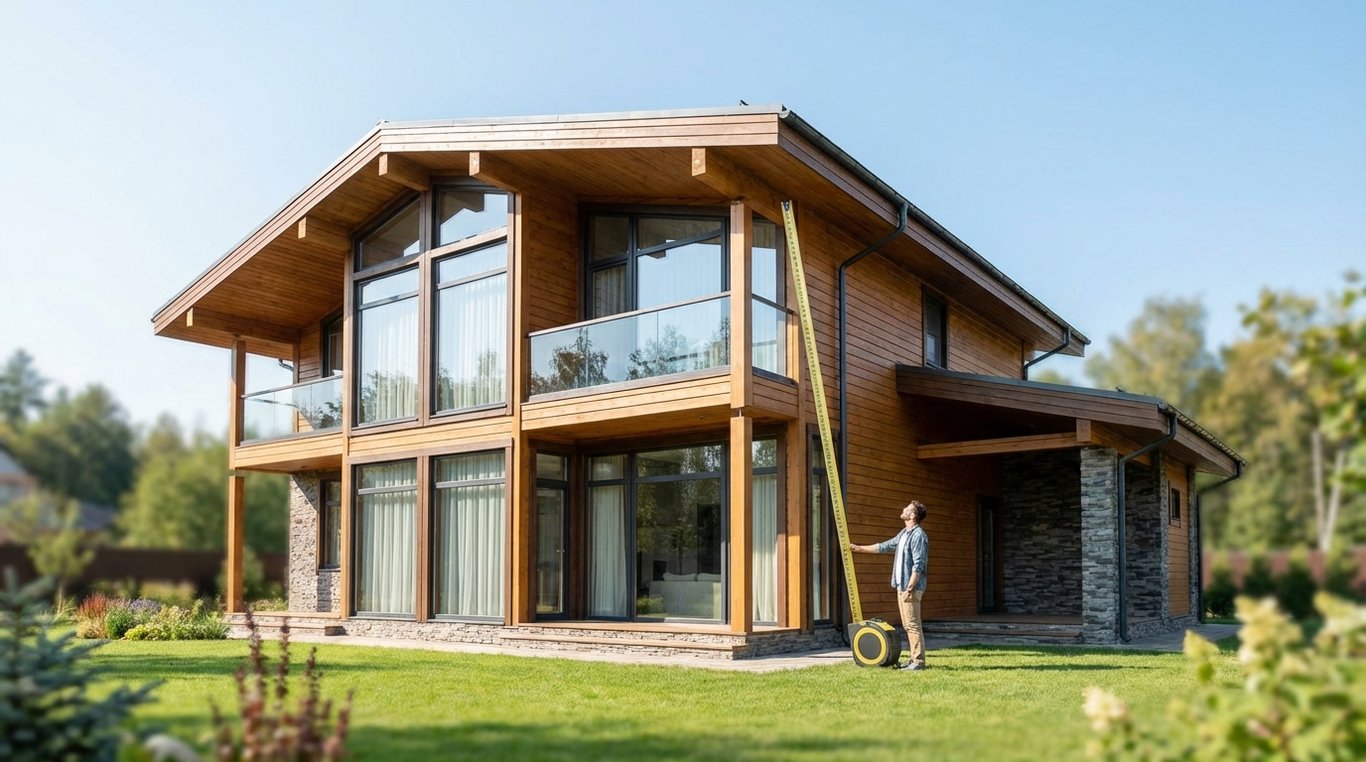

If you are wondering how high is a 2 story house, the practical short answer is this: most two-story houses are about 18 to 25 feet tall, or roughly 5.5 to 7.6 meters. In many suburbs, a very common real-world range is closer to 20 to 24 feet from grade to the roof peak. That gives you a useful rule of thumb, but it is not a fixed standard.
The reason there is no single number is simple: two homes can both be called “2-story” and still differ by several feet in total height. Ceiling heights, floor framing, roof pitch, parapets, foundation exposure, lot slope, and local zoning definitions all change the final measurement. A compact builder-grade home with 8-foot ceilings and a low roof can be near the bottom of the range, while a custom house with 10-foot ceilings and a steep gable can push into the upper 20s.
That difference matters in real estate and remodeling more than many people expect. Height affects curb appeal, maintenance access, ladder and lift requirements, neighborhood fit, and whether an addition or rebuild clears local height limits. If you need a quick estimate, this guide will give you one. If you need a more accurate number, it will show you what to measure and why two-story height is often debated.
Typical 2-story house height at a glance
A good starting point is to separate visible everyday height from code-measured height. Most people asking about house height want the visible total from the ground to the highest roof point. Zoning officials may use a different method, such as measuring to the midpoint of a sloped roof or from average grade instead of the lowest point.
| Home type | Typical height (ft) | Typical height (m) |
|---|---|---|
| Low-profile 2-story | 18–20 | 5.5–6.1 |
| Typical 2-story | 20–25 | 6.1–7.6 |
| Taller 2-story | 25–30 | 7.6–9.1 |
These ranges remain accurate for most detached homes in 2025, but newer construction trends have widened the gap between entry-level and upper-end homes. Many production houses still rely on 8- or 9-foot ceilings, while custom and semi-custom builds often use 10-foot first floors, taller window headers, and more dramatic rooflines. That is one reason “average” can be misleading unless you also know the home style and market.
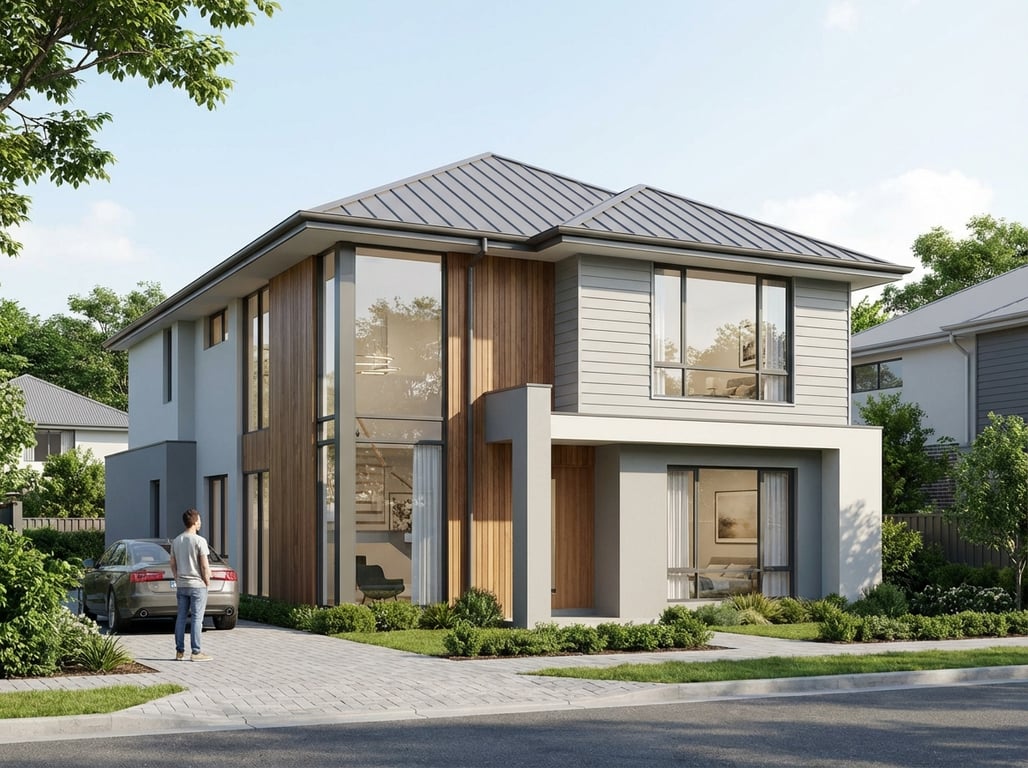
Why there is no single standard height
People often assume two stories should equal a set number, but a house is not just two stacked rooms. It is a vertical assembly made up of the first-floor structure, second-floor structure, and roof system. Change any of those layers and total height changes too.
Even homes with the same square footage can vary noticeably. A narrow traditional house with a steeper roof may stand taller than a wider modern home with the same interior area. Likewise, a house built on a crawl space with exposed foundation can read taller from the street than one built close to grade.
Another source of confusion is vocabulary. Homeowners may say “height” and mean ridge height. Builders may talk about wall height or floor-to-floor height. Planners may define height using average finished grade and the midpoint of the roof. Those are not interchangeable. A house can look 27 feet tall to a neighbor but still count as compliant under a 25-foot zoning rule if the local formula measures differently.
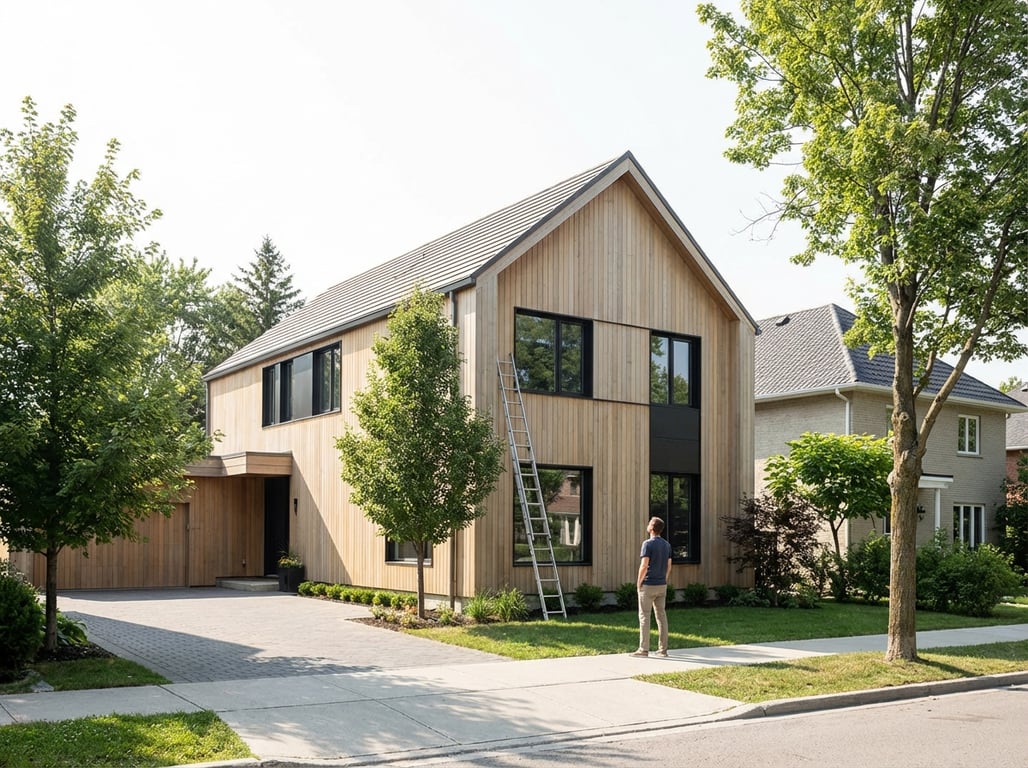
The main factors that determine total height
Ceiling heights on each floor
Ceiling height is one of the biggest drivers of overall height. Older and more modest homes often have 8-foot ceilings on both levels. Many newer homes use 9-foot ceilings on the first floor, with 8- or 9-foot ceilings upstairs. Higher-end homes may use 10-foot ceilings on the main level and 9 or 10 feet on the second floor.
A one-foot increase in ceiling height on each level can add about 2 feet to the home before roof changes are even considered. That is why a two-story house with 9-foot ceilings usually feels substantially taller than one with 8-foot ceilings, even when the footprint is similar.
Floor system thickness
Between the first and second floors, there is more than empty space. Joists or trusses, subfloor, drywall, and mechanical runs all take up vertical depth. In many homes, this floor assembly adds around 12 to 18 inches, though deeper engineered systems can exceed that.
This is a major reason a home with two 8-foot ceilings does not come out to just 16 feet overall. The structure between levels adds height, and then the roof adds more above that.
Roof shape and pitch
Roof design is often what makes two otherwise similar houses look very different in height. A shallow roof can keep a two-story home near the lower end of the range. A steep gable or complex roofline can add several feet quickly.
Common effects by roof type include:
- Low-slope or near-flat roofs usually keep total height lower.
- Gable roofs often create taller ridge heights.
- Hip roofs can appear lower than gables for the same wall height.
- Parapets on modern homes may reduce visible roof slope but still add exterior height.
- Decorative dormers do not always add much true height, but they can make the house look taller.
Foundation exposure and lot slope
The point where height measurement starts matters as much as the roof. On a flat lot, estimating height is fairly straightforward. On a sloped lot, the same home can appear much taller from the downhill side than from the street-facing side.
Walkout basements are the classic example. From the front, the house may read as a normal two-story. From the rear, it may look like two stories over a full exposed lower level. In hillside neighborhoods, this difference affects both buyer perception and permit review.
Local code definitions
Local rules remain the final authority when height matters for compliance. One city may measure from average grade to the midpoint between eave and ridge. Another may measure to the roof peak. A flat-roofed home may be measured to the top of the parapet instead.
For property owners planning additions, tear-down rebuilds, or rooftop features, the local definition is more important than any national average. If the exact number matters legally, check the zoning code or ask the building department rather than relying on the visual height alone.
A realistic stack-up for a standard 2-story house
The easiest way to answer how high is a 2 story house is to break it into layers. A typical suburban home might include a first-floor height of about 9 to 10 feet, a second-floor height of about 8.5 to 10 feet, and a roof rise of about 3 to 6 feet above the second-floor walls. Add those pieces together and you land in the familiar 20- to 26-foot zone.
Here is a simplified example:
- First floor, floor to floor: 10 ft
- Second floor to roof base: 9 ft
- Roof rise to ridge: 4 ft
Estimated total height: about 23 ft
That same house could drop closer to 20 feet with lower ceilings and a shallow roof. It could also climb to 27 feet or more with 10-foot ceilings, deeper framing, or a steeper pitch. This layered approach is more useful than guessing from story count alone.
Floor-to-floor height vs. total house height
A lot of misunderstanding comes from mixing up interior room height with full building height. Floor-to-floor height is the distance from one finished floor surface to the next. Total house height is the full exterior measurement from grade to the relevant top point.
| Ceiling setup | Typical floor-to-floor height |
|---|---|
| 8-foot ceiling | 9–10 ft |
| 9-foot ceiling | 10–11 ft |
| 10-foot ceiling | 11–12 ft |
This distinction matters when reading plans. If a builder says the home has 10-foot ceilings on the first floor, that does not mean the exterior only rises 10 feet at that level. The floor framing and finish layers usually push floor-to-floor height above the ceiling height. Once the second level and roof are added, total height is much greater.
How style changes the height of a two-story home
Architectural style strongly influences both actual height and perceived height. A standard suburban two-story with moderate roof pitch often lands around 20 to 24 feet. A modern boxier design with a low-slope roof may sit around 18 to 22 feet, even when interior space is generous.
Traditional styles such as Colonial, Craftsman, and farmhouse designs often end up taller, often around 22 to 27 feet, because they tend to use stronger roof forms, taller façade proportions, and more visible gables. Luxury homes can go beyond that with oversized entry volumes, taller ceilings, and more elaborate framing.
This matters in real estate because buyers do not usually ask for official ridge height, but they react instantly to scale. A taller house can read as grander and more expensive. It can also feel out of place if neighboring homes are lower and simpler, which is one reason local design review boards increasingly scrutinize massing as well as raw square footage.
How to estimate height from plans, photos, or on site
If you do not have a survey or permit set, you can still estimate height fairly well. The best method is to work from known dimensions. A standard exterior door is usually about 6 feet 8 inches tall, and a typical garage door is often 7 or 8 feet tall. In a straight-on photo, those can serve as scale references.
For on-site estimating, count visible siding courses, brick courses, or stair risers, then compare them with known dimensions. Laser distance tools also make rough field estimates easier than they were a few years ago, especially for agents, inspectors, and contractors doing preliminary assessments.
If you have plans, look for the exterior elevation sheets and building sections. Those documents usually show floor-to-floor heights and roof geometry, which are enough to estimate total height accurately. If you are comparing properties, details like lot slope and grading or roof pitch basics can explain why homes with similar square footage look different in height.
Why the number matters in practice
Height matters because it affects cost, compliance, and marketability. From a maintenance standpoint, a 24-foot house may require taller ladders, more staging, or lift equipment for painting, siding, and window work. Roof access, gutter cleaning, and exterior repairs all become more involved as height increases.
From a development standpoint, height limits remain a live issue in 2025, especially in infill neighborhoods where rebuilds are pushing against tighter zoning envelopes. Small design choices such as raising plate heights, adding a parapet, or changing roof pitch can make the difference between a by-right plan and a redesign.
For real estate professionals, the number also shapes buyer perception. Height contributes to curb presence and can affect how large a home feels before a buyer even walks inside. It also influences privacy concerns, shadowing, and neighborhood compatibility, all of which come up in listing conversations and redevelopment analysis.
How a 2-story house compares with 1-story and 3-story homes
A one-story house often falls somewhere around 10 to 18 feet tall, depending mainly on ceiling height and roof pitch. A two-story house usually occupies the middle band at 18 to 25 feet, with taller examples reaching 25 to 30 feet. A three-story home often starts around 30 feet and can go well beyond that depending on roof type and local measurement rules.
That comparison is useful when evaluating neighborhood scale or estimating future construction nearby. If someone is concerned about sightlines or whether a new build will tower over adjacent homes, story count alone is not enough. A tall two-story can rival a compact three-story in visual impact, especially on a raised lot.
So, how high is a 2 story house?
For most practical purposes, a standard 2-story house is about 18 to 25 feet tall, and many typical detached homes fall around 20 to 24 feet. In metric terms, that is about 5.5 to 7.6 meters, with taller homes reaching roughly 7.6 to 9.1 meters.
If you need more than a ballpark number, focus on five variables: ceiling heights, floor assembly depth, roof shape, grade conditions, and the local code definition of height. Those factors explain most of the difference between a compact two-story and one that feels significantly taller from the street.
FAQ
How high is a 2-story house in feet?
Most two-story houses are about 18 to 25 feet tall. In many neighborhoods, a common practical range is 20 to 24 feet.
How high is a 2-story house in meters?
A typical 2-story house is around 5.5 to 7.6 meters tall. Taller designs can reach about 7.6 to 9.1 meters.
How tall is a 2-story house with 9-foot ceilings?
Many two-story houses with 9-foot ceilings on both floors end up around 22 to 26 feet tall, depending on floor framing and roof pitch.
Does a basement count toward house height?
Not always. A basement may not add to official code height if it is mostly below grade, but it can add visible height, especially on a sloped lot or in a walkout design.
Is roof height included in the total house height?
Usually yes. In everyday use, total house height generally means the measurement from grade to the roof peak or another code-defined top point.
Are all 2-story houses under 25 feet?
No. Many are, but houses with taller ceilings, steeper roofs, parapets, or more exposed foundation can exceed 25 feet while still being only two stories.